
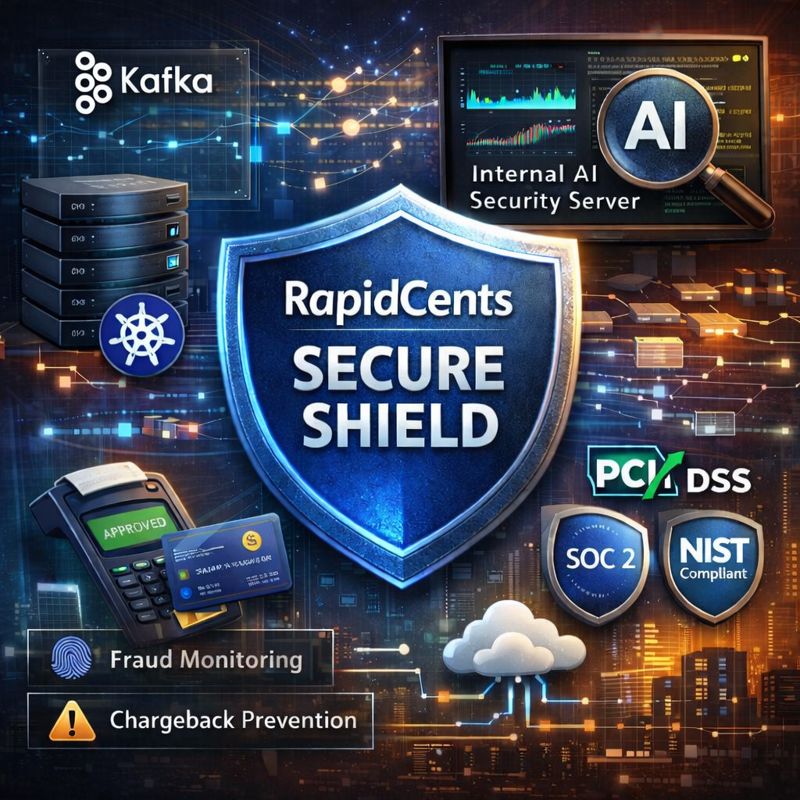
I’m Mani Rahnama, founder of RapidCents. I get a lot of questions from developers and security folks about what’s “under the hood” , not the marketing layer, but the actual engineering decisions behind the RapidCents system and why we’ve been so aggressive about security from day one.
Payments is a hostile environment. You’re operating in a space where every API is a target, every edge case costs real money, and every incident becomes a trust event. “We’ll harden it later” is not a strategy.
This post is a technical overview of the RapidCents infrastructure patterns we’re using, how we think about secure-by-design systems, and how we implement RapidCents Security via our Secure Shield program (runtime controls, auditability, and risk enforcement).
Design principles: what we optimize for
Before the stack, here are the operating constraints we design around:
- Consistency and correctness > novelty. Payments is state machines and invariants, not “move fast and break things.”
- Defence-in-depth across identity, runtime, data, and network boundaries.
- Auditability as a first-class feature. If you can’t reconstruct what happened, you’re not production-ready.
- Failure isolation. Dependencies fail. Partners fail. Retries storm. Your platform must degrade safely.
1) Event-driven backbone: Kafka as the platform spine
The RapidCents system is built as a set of bounded services around a stream of domain events: authorization attempts, captures, refunds, reversals, settlement updates, disputes, ledger postings, risk signals, and compliance/audit events.
We use Kafka as an event backbone because it gives us:
Event durability + replay
- Stream persistence enables deterministic replay and reprocessing, which matters when you’re reconciling settlements or rebuilding derived views (e.g., merchant dashboards, risk aggregates, reporting).
Decoupling + backpressure control
- Producers don’t need to block on downstream consumers.
- Consumers can scale horizontally and handle burst traffic with controlled lag rather than cascading failure.
Stronger operational posture
- Partitioning strategy enables concurrency while preserving ordering where required (per merchant, per account, per payment intent, etc.).
- Schema discipline enables long-term evolution without breaking consumers.
If you’ve built payment systems, you already know the hardest part isn’t “handling a charge” , it’s handling the edge conditions (retries, partial failure, duplicate delivery, out-of-order events). The event backbone is where we enforce those constraints.
Security implications: events become a privileged surface. We treat topics as sensitive assets: strict ACLs, scoped service principals, and traceability of event production/consumption.
2) Data layer: reliability-first storage with “DBaaS” discipline
Payment data needs two contradictory properties: it must be boringly correct, and it must scale under unpredictable load.
Our design approach is DBaaS-inspired:
- Elasticity (sharding, controlled distribution)
- Online change (migrations without outages)
- Tenant scaling path (multi-tenant efficiency with a route to stronger isolation for large customers)
From a systems perspective, this is about:
- minimizing blast radius under noisy neighbours
- enabling data movement without breaking API contracts
- building operational tooling that makes change safe
Security implication: your data model is your security model. We design for:
- tenant isolation boundaries (hard, not “best effort”)
- encryption expectations and key separation
- audit trails for privileged data access
- controls that prevent lateral movement across tenants
3) Compute orchestration: Kubernetes for standardized runtime controls
We run Kubernetes to standardize how services are deployed, scaled, and isolated across environments.
What matters (for security/ops engineers) isn’t “we use K8S” , it’s what that enables:
- Consistency across environments for deployment and configuration
- Workload isolation and controlled resource boundaries
- Scalability primitives that prevent outages during growth spurts
- Policy enforcement (identity, networking, admission controls) as a platform capability
Security implication: Kubernetes is not secure “by default.” Secure Shield assumes:
- strict RBAC with least privilege
- workload identity/service account discipline
- network segmentation between services
- configuration hardening + drift detection
4) API edge hardening: rate limiting, concurrency limits, and load shedding
Payment APIs are exposed to:
- brute-force attempts
- credential stuffing
- retry storms from upstream outages
- flash sale surges
- abusive clients “accidentally” DOS’ing you
So RapidCents infrastructure uses multiple layers of protection:
- RPS rate limiting (per tenant / per key / per endpoint class)
- Concurrency limits (protects downstream dependencies)
- Load shedding under extreme conditions (better to fail fast than queue into collapse)
This is not about “throttling customers.” It’s about preserving platform integrity and preventing one integration from degrading everyone else.
Security implication: These controls double as attack surface reduction. They limit the effectiveness of enumeration attacks and reduce the blast radius of misbehaving integrations.
5) Observability + audit-grade logging: “prove what happened.”
If you can’t answer these quickly, you’re not running a payments platform, you’re gambling:
- What happened to transaction X?
- Who/what changed the config at time T?
- Was this a retry, replay, or duplicate submission?
- Did we respond with a 4xx/5xx and why?
Our observability pipeline is built for incident response and long-term accountability:
- Canonical structured logs at API and service boundaries
- Asynchronous emission to avoid request-path coupling
- Long retention for forensic analysis and disputes
- Stable schema contracts so log data stays queryable over time
Security implications: logs are sensitive. Secure Shield treats observability as an asset:
- minimize PII exposure in log fields
- Protect log pipelines as production-tier systems
- enforce access control and immutable retention where required
- record privileged actions and configuration changes (audit trails)
RapidCents Security: Secure Shield (security as a runtime system)
Security isn’t a checkbox. It’s a continuous enforcement layer across identity, runtime, data, and transaction behaviour.
Secure Shield focuses on three domains:
A) Security foundations: controls, access, evidence
We build toward enterprise-grade expectations in payments:
- tight access discipline (least privilege, scoped roles)
- change traceability for production-impacting actions
- secure SDLC practices that make “safe change” a repeatable process
In payments, the strongest security posture is useless if it’s not operationally repeatable. Secure Shield is designed to be enforceable daily, not just documented.
B) Runtime monitoring + transaction intelligence (risk is streaming, not batch)
Fraud, abuse, and disputes are temporal problems. Detection is about:
- velocity patterns
- inconsistent behavioural profiles
- abnormal failure/retry patterns
- suspicious authorization sequences
- anomaly signals across merchants, devices, and payment attributes
We treat risk as a streaming system: detection must happen in the same time horizon as the event stream.
C) Internal AI security server: audit + monitoring + fraud + chargeback prevention
We run an internal AI server to support security and risk operations across the platform:
1) Security audit + checks
- Detect common misconfigurations and security anti-patterns
- Support engineering review workflows with risk signal extraction
- Assist with consistency checks across services (policy drift, unexpected exposure patterns)
2) Transaction monitoring
- real-time monitoring across transaction lifecycles
- anomaly detection signals for operational triage
- incident correlation across services and event streams
3) Fraud control
- layered controls (rules + scoring + adaptive models where appropriate)
- feedback loops from disputes and chargeback outcomes into detection refinement
4) Chargeback prevention system
Chargebacks are not just a “support issue.” They’re a data + process problem:
- poor evidence trails
- inconsistent descriptors and customer comms
- high-risk patterns not stopped early
- delayed detection of compromised credentials or abusive behaviours
We built dedicated chargeback prevention workflows to reduce avoidable disputes and strengthen evidence quality when challenges occur.
Engineering for trust, not just throughput
A payments company ultimately sells one thing: trust. Throughput and feature lists matter, but trust is built through:
- predictable failure modes
- strong auditability
- measurable security controls
- transparent operational behaviour under stress
That’s what we’re building with RapidCents technologies, the RapidCents system, and the RapidCents infrastructure , and why RapidCents Security (Secure Shield) is implemented as a runtime capability, not a tagline.
If you’re a developer, security engineer, or platform operator and want to trade notes on event-driven payments, auditability, and risk systems, I’m always open to the conversation.