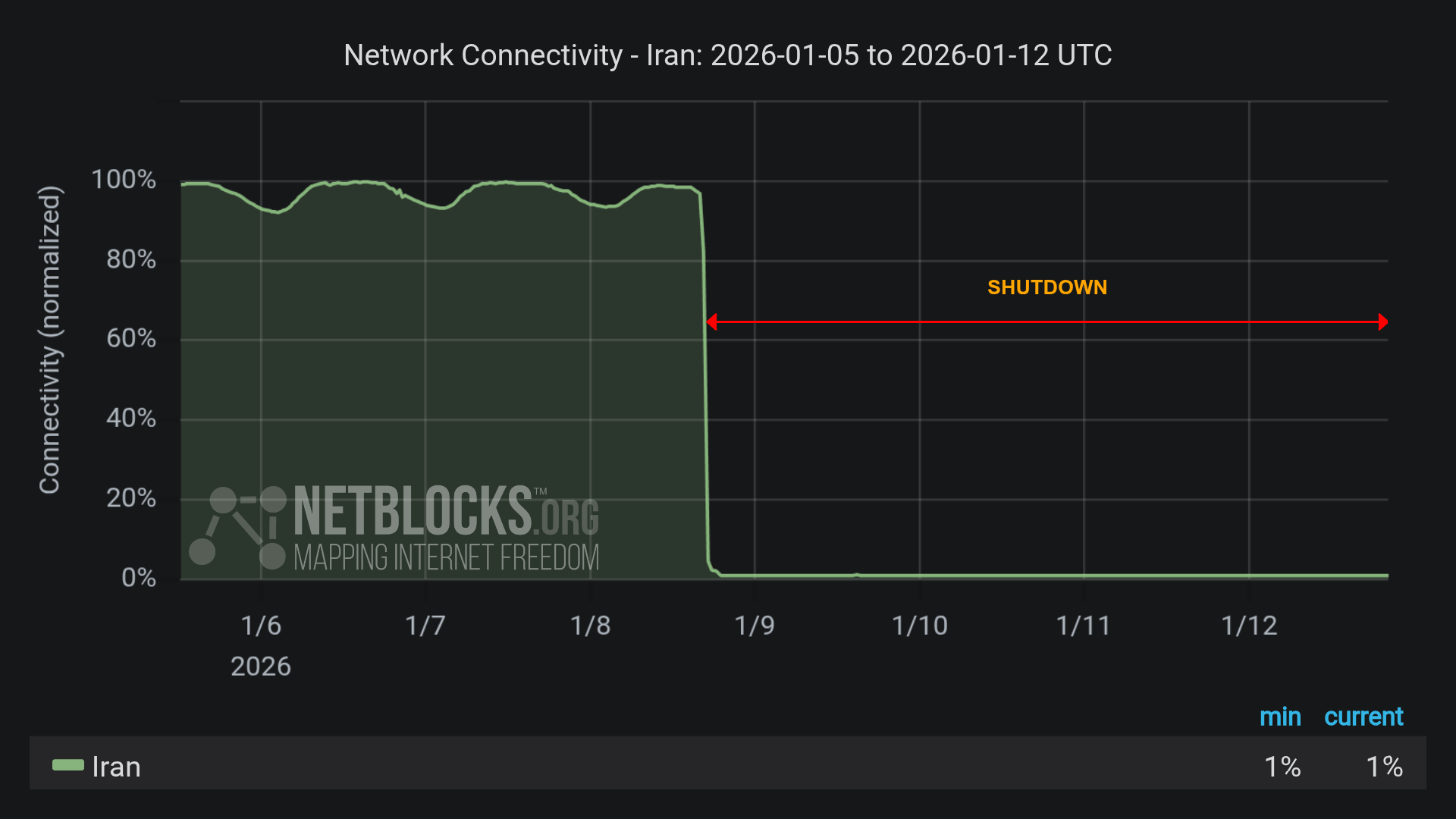
As of Monday, January 12, 2026, Iran has been under a total communications blackout since January 8.
Five days. That’s how long millions of people inside Iran have been pushed into forced silence, no internet, disrupted communications, and a country cut off from the world at the exact moment people need to document what’s happening, find loved ones, and stay alive.
Independent monitors and major outlets have reported that the nationwide shutdown that began January 8, 2026 has dropped non-satellite connectivity to around 1% of normal levels, with only small pockets of access remaining.
And here’s the part that should haunt anyone who reads this: this kind of “digital darkness” isn’t a side effect. Human rights groups say it’s a tactic , a way to hide what happens next.
What we know (and why the blackout matters)
The current wave of unrest reportedly began December 28, 2025, after economic shocks including a currency collapse and surging inflation , and rapidly evolved into broad anti-government protests.
Then came the shutdown: NetBlocks, Cloudflare, and IODA all registered a sharp, synchronized collapse in connectivity as the blackout hit.
Amnesty International says the shutdown is being used to conceal serious human rights violations and describes it as a rights violation in itself.
Even in the darkness, fragments still leak out , often through satellite links. Reuters reports some people are using Starlink, though access is “patchy,” expensive, banned, and reportedly subject to interference/jamming.
The point I need you to sit with
You asked me to make these points bold , and I will , but I will also keep them anchored to what credible sources actually document.
1) Security forces are using guns on civilians , and they do not hesitate.
Amnesty International and Human Rights Watch report unlawful lethal force and firearms used against protesters and bystanders , including children , in multiple cities.
And while the government insists its nuclear program is “peaceful,” it is simultaneously treating unarmed public protest like a battlefield. Iran repeatedly states it seeks nuclear energy for peaceful purposes, while the IAEA has reported Iran accumulated hundreds of kilograms of uranium enriched up to 60% (a level far above civilian power fuel), heightening international concern.
2) In the last few years, the Islamic Republic’s protest crackdowns have reached a scale of killing that is among the deadliest in Iran’s modern history , carried out against its own people.
Amnesty documents thousands killed in the November 2019 crackdown alone.
During the 2022 “Woman, Life, Freedom” uprising, major rights groups documented lethal force and abuses , including against children , and a UN fact-finding mission reported serious violations and urged accountability.
And now, in this current crisis, death toll estimates vary widely, but multiple reputable outlets cite large numbers and mass detentions , with the blackout making verification harder, not less urgent.
(Important honesty: exact totals are disputed and hard to confirm during blackouts. That uncertainty is why shutting down the internet is so powerful for a regime , it forces the world to argue about numbers while people die unseen.)
Who is enforcing this?
Reports describe Iran relying on a familiar machinery of repression: the Islamic Revolutionary Guard Corps (IRGC) and affiliated forces (including Basij), alongside police and security agencies, to crush unrest.
This is not only about ideology. Reuters also notes the IRGC’s deep control over major sectors of Iran’s economy — making it not just a military force, but a pillar of the system people are protesting against.
Why “Iran going dark” should terrify all of us
When a government turns off the internet, it doesn’t just shut down social media.
It shuts down:
- the ability to call for medical help
- the ability to prove who was arrested
- the ability to show the world who was shot
- the ability to organize safely
- the ability for families to find missing people
And it gives violent power what it always wants most: time. Time to raid. Time to disappear people. Time to threaten witnesses. Time to bury bodies before the world can count them.
Some outlets describe overwhelmed morgues and graphic evidence emerging through limited channels , the kind of reporting that becomes possible only when someone risks everything to get a signal out.
What you can do (non-violent, real-world impact)
If you’re reading this outside Iran, you have privileges people inside Iran are being denied: a voice, a signal, and safety. Use them.
- Share verified reporting from reputable outlets and human rights organizations (Amnesty, HRW, UN reporting).
- Contact your elected officials and demand targeted action: sanctions on individuals responsible for abuses, support for UN accountability mechanisms, and pressure to restore connectivity.
- Support human-rights documentation efforts (donations/volunteering) that preserve evidence for future prosecutions.
- Keep attention on the blackout itself , because silence is part of the violence.
Final thought
A government that fears its people’s voices will always try to destroy the tools that carry those voices.
Iran is not “offline” because of a technical failure. Iran is being forced into darkness — because darkness makes brutality easier.
If you have a platform, any platform —>use it.
If you have a voice —> raise it.
Because right now, millions of people are being denied both.