The more time I spend around payment infrastructure, the more I notice something that bothers me.
A lot of pain in this industry has been accepted as normal.
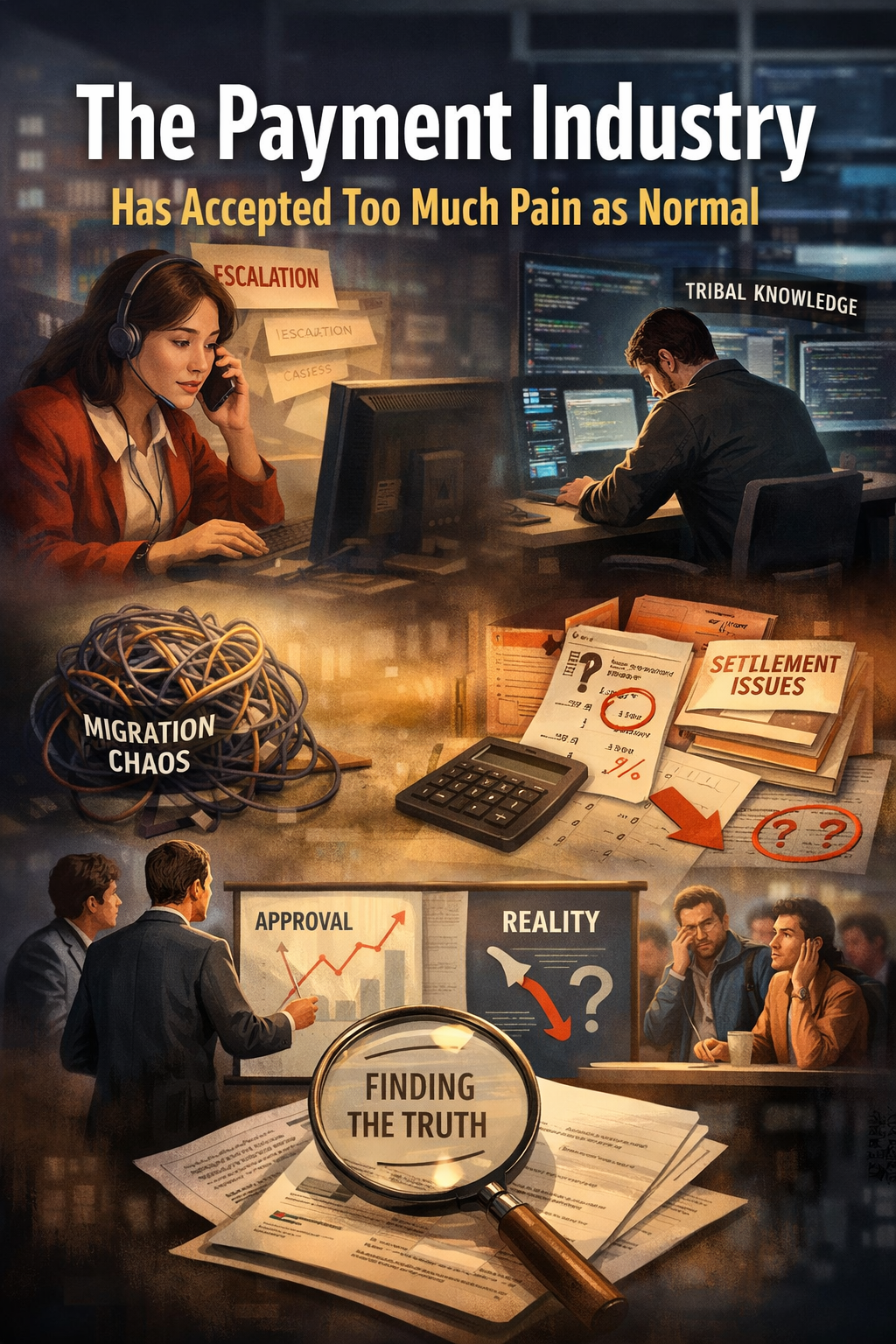
People accept that migrations will be stressful.
People accept that support will need to escalate basic questions.
People accept that settlement and reconciliation will sometimes become messy.
People accept that critical workflows will depend on one engineer who knows how things really work behind the scenes.
People accept that a platform can look good in a presentation and still become difficult to trust in production.
That should not be normal.
But in many environments, it is.
Not everywhere. Not always. But often enough that I keep seeing the same things come up, again and again, regardless of the platform, the company size, or how recently someone “modernized.”
Let me be specific.
The Pain We Stopped Questioning
Migrations. Every time a team migrates to a new payment processor or switches acquirers, there’s this accepted cloud of stress that follows it. Timeline slippage. Surprise edge cases. Late nights the week before go-live. I’ve seen teams that treated a clean migration as a minor miracle , and they weren’t wrong, given what they’d been through before.
Settlement and reconciliation. I’ve sat in calls where a finance team was manually cross-referencing CSVs from three different systems trying to figure out why a $47,000 discrepancy appeared at month-end. The answer took nine days and one very tired analyst to find. That’s not a corner case. That’s Tuesday for some organizations.
The one engineer who knows everything. You know exactly who I’m talking about. The person who built the webhook logic three years ago and whose Slack handle gets typed into the search bar every time something unusual happens in production. If they’re on vacation, people wait. If they leave the company, there’s a quiet panic that nobody says out loud.
Platforms that look different in a deck versus in production. Beautiful API documentation. Elegant architecture diagrams in the sales call. Then you get into real operating conditions , high volume, a downstream partner misbehaving, a refund edge case , and you start to see the seams.
None of this is inevitable. But in too many environments, it’s been accepted as the cost of doing business in payments.
Why Does This Keep Happening?
Part of it is how we talk about progress.
The industry defaults to celebrating connectivity. Faster rails. More integrations. Unified APIs. And honestly, those things matter , I’m not dismissing them.
But there’s a different layer of the stack that gets underinvested in, quietly, over and over. And that layer is trust infrastructure.
Here’s what I mean.
Moving a transaction from point A to point B is not the whole job. The real job , the one that determines whether an organization can actually operate with confidence , is everything that happens around the transaction.
Can your team explain exactly what happened when a payment settled differently than expected?
Can you compare how your system behaves before and after a routing change, with actual evidence, not just hope?
Can your finance team close their books without three Slack threads and a shared Google Sheet that only one person fully understands?
Can a support agent handle a complex dispute without needing to escalate to engineering for basic transaction context?
Can your leadership actually believe, under real pressure, that the payment layer is under control?
These aren’t edge case questions. These are the questions that come up constantly in mature payment operations , and they’re the ones that reveal whether a platform has been built for demos or for reality.
What Low Confidence Actually Costs
I think the industry underestimates what low confidence does to an organization.
When teams don’t fully trust their payment infrastructure, the cost shows up everywhere , just not on a single line item.
Migrations take longer because nobody wants to commit until every possible edge case has been manually verified. A project that should take eight weeks takes six months because the team doesn’t have the tools to validate what “working correctly” actually looks like.
Incidents take longer to resolve because reconstructing what happened requires pulling logs from multiple places, cross-referencing systems that don’t share a common timeline, and eventually tracking down the one person who might remember the relevant context.
New product launches get delayed because finance needs extra comfort before signing off on a new payment flow. Not because they’re being difficult , because the last three times they were surprised, it hurt.
Every conversation between product, ops, finance, support, and engineering gets just a little bit harder, a little bit slower, because there’s an invisible tax on every decision that touches the payment layer.
That tax compounds. And most organizations don’t see it clearly because it looks like normal operational friction rather than a systemic problem with their infrastructure.
The Standard I Think We Should Be Holding
I’m not interested in platforms that are faster in a benchmark but harder to operate in practice.
The next generation of payment infrastructure needs to do something harder than processing more transactions per second. It needs to reduce the operational fear that comes with running payments at scale.
That means:
Teams should be able to investigate a discrepancy without a scavenger hunt. A payment that behaves unexpectedly should generate enough observable signal that the answer is findable in minutes, not days.
Migrations and changes should come with comparison tools, not just documentation. “It works the same as before” should be provable, not assumed.
Support should be able to answer questions that today require an engineer. Not because engineers aren’t valuable , but because tribal knowledge is a fragility disguised as expertise.
Finance should be able to trust the downstream truth without maintaining their own shadow reconciliation system.
Leadership should be able to walk into a board meeting or a regulatory review with actual confidence in the data, not a carefully managed narrative built around uncertainty.
Why I Think This Moment Matters
The conversations I’ve been having lately feel different.
There’s a growing recognition that “more connected” and “more trustworthy” are not the same thing. That upgrading your payment stack can make your reconciliation problem worse if you add complexity without adding visibility. That the right question isn’t just “can we process this transaction” but “can we understand, explain, and stand behind what happened.”
That’s a harder standard. Building for it is genuinely difficult work.
But I believe it’s the right one. And I think the organizations that demand it , and the platforms that rise to meet it , are going to define what serious payment infrastructure looks like for the next decade.
The industry is ready for this conversation.
I’m glad it’s finally starting.