There is a question we ask young people constantly:
What do you want to become?
A doctor?
An engineer?
A programmer?
An entrepreneur?
A lawyer?
Something in finance?
Something in the arts?
And increasingly, there is another version of the same question:
What career will still be valuable ten years from now, especially with AI changing everything?
These are reasonable questions.
But I think there is a question that should come before all of them:
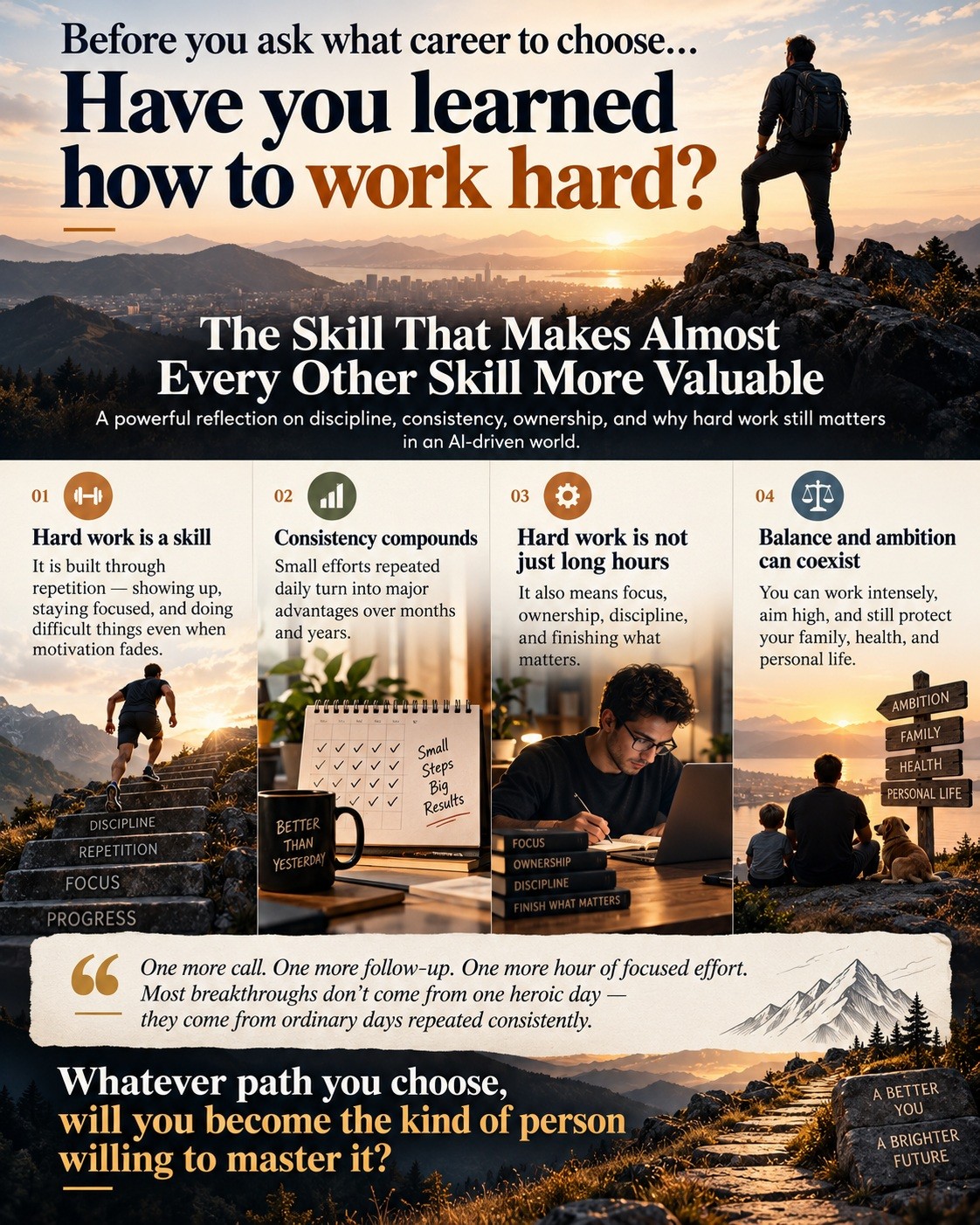
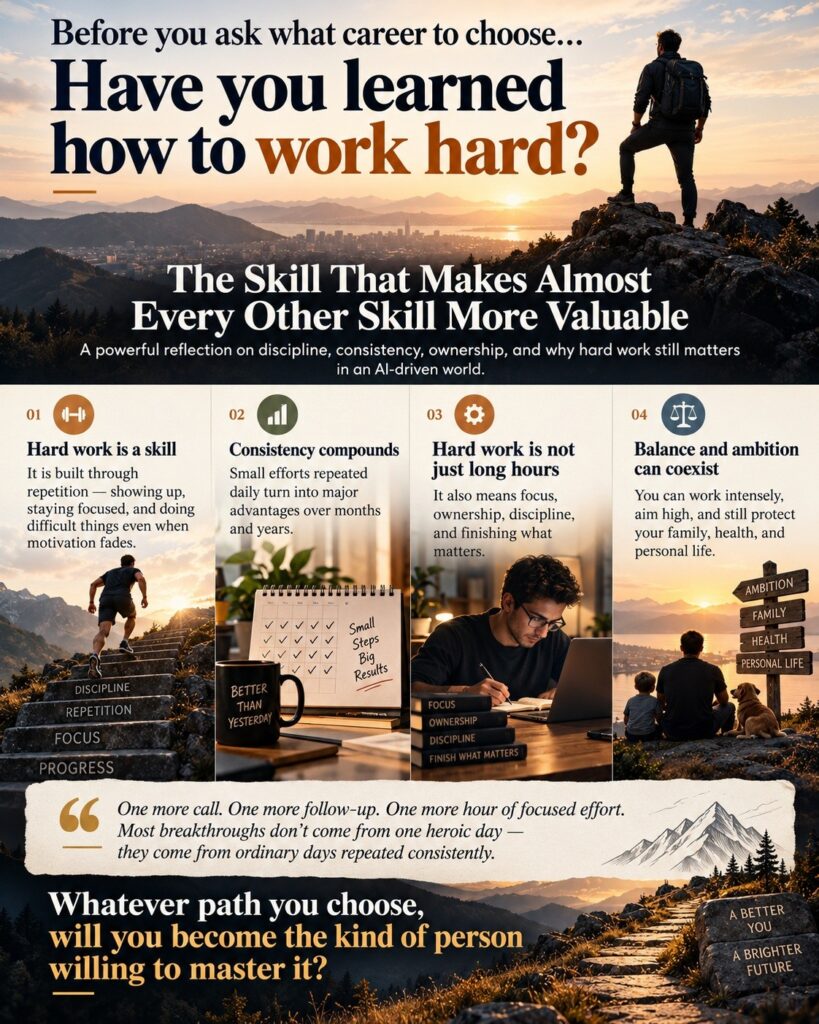
Have you learned how to work hard?
Not what degree you have.
Not what industry you choose.
Not how intelligent you are.
Not how ambitious you sound.
Have you actually developed the ability to sit down, focus, solve problems, tolerate frustration, keep your word, and continue working when you would rather stop?
Because before you become an exceptional programmer, salesperson, doctor, athlete, engineer, entrepreneur, or anything else, you need to become someone who can consistently do difficult things.
And that ability makes almost every other skill more valuable.
Hard Work Is a Skill
People sometimes talk about work ethic as though you either have it or you don’t.
I don’t believe that.
I think hard work is trainable.
It is almost like a muscle.
The first time you force yourself to keep going when you are mentally tired, it is difficult.
The twentieth time is still difficult.
But eventually you develop a different relationship with discomfort.
You stop expecting every day to feel good.
You stop needing to be motivated before you begin.
You stop negotiating with yourself every time something becomes inconvenient.
That matters.
Because motivation is unreliable.
Anyone can work when they are excited.
The beginning of almost anything is exciting.
A new business.
A new job.
A new project.
A new gym membership.
A new idea.
The first few days are easy because your brain is receiving something new.
The real test comes later.
It is Tuesday afternoon.
Nothing exciting is happening.
You didn’t sleep perfectly.
You have ten things on your mind.
The project that seemed exciting three months ago has become repetitive.
Nobody is congratulating you.
Nobody is watching.
That is where work ethic starts to matter.
You do the work anyway.
Not because you feel inspired.
Because you decided it needs to be done.
Some of the Most Important Work Happens on the Days You Don’t Feel Like Working
There have been days in business when I have felt incredibly energized.
Everything moves quickly.
Problems get solved.
Meetings go well.
You feel like you could work forever.
Those days are easy.
The more important days are often the opposite.
The days when you wake up tired.
The days when something didn’t go according to plan.
The days when a deal you expected doesn’t happen.
The days when a technical problem appears at exactly the wrong time.
The days when you already solved five problems and suddenly number six arrives.
You still have a choice.
You can tell yourself, Today isn’t my day.
Or you can say:
I may not have my best energy today, but I can still give this day something.
Maybe today you don’t produce your greatest work.
Fine.
Make the call.
Answer the email.
Fix the issue.
Review the numbers.
Follow up with the customer.
Complete the task you promised you would complete.
That is also hard work.
In fact, I would argue that this is one of the most important forms of hard work.
Doing what needs to be done when your emotions aren’t helping you.
Watch the People at the Very Top
Think about elite athletes.
Cristiano Ronaldo is an easy example.
Michael Jordan is another.
Obviously, talent matters.
It would be ridiculous to pretend otherwise.
At that level, you’re looking at people with extraordinary physical gifts.
But millions of talented people never reach the top.
Talent explains part of the story.
It doesn’t explain all of it.
What separates people at that level is often what happened when nobody was watching.
Another repetition.
Another training session.
Another year.
Another adjustment.
Another weakness worked on until it wasn’t such a weakness anymore.
We see the stadium.
We see the championship.
We see the highlight.
We don’t see the thousands of ordinary days that created the highlight.
And business is exactly the same.
People eventually see the successful company.
They don’t see the Tuesday night five years earlier when someone was still working through a problem everyone else thought was too small to matter.
They don’t see the hundredth sales call.
They don’t see the proposal that had to be rewritten.
They don’t see the customer complaint that turned into an improvement.
They don’t see the product that failed before the product that worked.
Success is very visible.
Preparation is usually invisible.
Business Doesn’t Care How Smart You Sound
I’ve met very intelligent people.
I’ve met people who can explain a business strategy beautifully.
They understand markets.
They understand technology.
They understand finance.
They can tell you exactly what should be done.
But knowing what should be done and actually doing it are two very different things.
You can have a brilliant product and never sell it.
You can understand sales and never make the calls.
You can build the perfect strategy and never execute it.
You can identify every problem in your company and postpone fixing all of them.
You can spend six months perfecting a plan that somebody else starts executing tomorrow.
Meanwhile, another person may have fewer advantages.
Less money.
Less experience.
Maybe even less natural talent.
But every day, that person moves something forward.
One more phone call.
One more customer.
One more product improvement.
One more conversation.
One more lesson.
One more problem solved.
At first, the difference doesn’t look significant.
That’s what makes consistency so easy to underestimate.
Small Effort Becomes a Big Difference
Imagine two people starting at approximately the same level.
One works extremely hard when motivated.
The other creates a habit of working consistently whether motivation appears or not.
After seven days, there might be almost no difference.
After thirty days, maybe a small one.
After a year, you start noticing something.
After five years, they can look like completely different people.
One has made thousands more attempts.
Had hundreds more conversations.
Made more mistakes.
Learned more lessons.
Built more relationships.
Developed better judgment.
And because you only see the final version of that person, you might say:
“They’re just talented.”
Sometimes they are.
But sometimes what we call talent is partly the result of watching someone after ten years of practice without having watched the ten years.
One extra effort rarely changes your life.
Thousands of them can.
That is the compounding effect of hard work.
But What About Work-Life Balance?
This is where I think the conversation often becomes unnecessarily divided.
Some people hear “work hard” and assume it means:
Work every hour.
Ignore your family.
Never exercise.
Never take a vacation.
Never sleep.
Destroy your health.
Measure your worth by how exhausted you are.
I don’t believe in that.
I believe in work-life balance.
I also believe deeply in working hard.
Those ideas are not contradictory.
The problem is that we sometimes define work-life balance too narrowly.
Balance doesn’t have to mean that every individual day is divided perfectly.
Eight hours for work.
Eight hours for yourself.
Eight hours for sleep.
Life doesn’t always happen that way.
There may be a period when you’re launching something important and you work ten-hour days.
There may be a critical week when you work twelve.
There may even be an unusual day when you work fifteen.
And there may be another day when you finish early and have dinner with your family.
Another afternoon when you take your child somewhere.
Another week when you travel.
Another weekend when you completely disconnect.
Balance is not necessarily a mathematical equation calculated every twenty-four hours.
Sometimes balance is something you evaluate over a week.
Sometimes over a month.
Sometimes even over a season of your life.
The important thing is that an intense period doesn’t quietly become permanent neglect of everything else that matters.
Working Hard Is Not the Same as Working Long
This distinction matters even more.
Somebody can sit in an office for twelve hours and accomplish almost nothing.
Another person can accomplish more in six focused hours.
Hours alone are a terrible measurement of work ethic.
Hard work can mean working longer when the situation genuinely requires it.
But it also means much more than that.
Hard work is concentration.
Hard work is preparation.
Hard work is doing the thing you’ve been avoiding.
Hard work is having the uncomfortable conversation.
Hard work is learning something you aren’t naturally good at.
Hard work is checking your work one more time before sending it.
Hard work is taking responsibility instead of searching for someone to blame.
Hard work is staying focused when your phone is two inches away from you.
Hard work is finishing.
And one of the hardest forms of work is showing up on a day when you have no energy and still refusing to give the day away completely.
Sometimes hard work means staying until midnight.
Sometimes hard work means becoming disciplined enough to finish by 5:00.
Both can be true.
Freedom Requires Discipline
I actually think flexibility makes discipline even more important.
Imagine two people working remotely.
Both have complete freedom over their schedules.
One interprets freedom as:
“I can work whenever I feel like it.”
The other interprets freedom as:
“Nobody needs to watch me because I know what I am responsible for.”
Those are completely different mindsets.
The second person has real freedom because they can be trusted with it.
That person can work from home.
From another city.
From another country.
At unusual hours.
They don’t need somebody checking whether they are sitting at a desk every fifteen minutes.
Why?
Because their results speak for them.
That’s the kind of flexibility I believe in.
High freedom. High responsibility. High standards.
Flexibility and work ethic are not enemies.
When done properly, they strengthen each other.
The Real Question Is: What Are You Building Your Life Around?
If somebody works fifteen hours every day because they are terrified to stop, that’s not necessarily ambition.
If somebody is permanently unavailable to everyone they love, that’s not automatically success.
If somebody damages their health while building a company, eventually the company may end up paying for that too.
But the opposite extreme doesn’t make sense either.
We shouldn’t become afraid of effort.
We shouldn’t teach people that discomfort automatically means something is wrong.
Some things worth having are difficult.
Building a company is difficult.
Becoming excellent at a profession is difficult.
Learning a language is difficult.
Raising children is difficult.
Getting physically fit is difficult.
Mastering an instrument is difficult.
Being excellent at almost anything requires periods where you would rather stop and you continue anyway.
The goal shouldn’t be to remove difficulty from life.
The goal should be to choose difficulties worth enduring.
A Small Story About One More Call
Imagine a salesperson near the end of the day.
It’s 4:55.
They’ve been rejected repeatedly.
Nobody answered the last several calls.
The easiest decision in the world is:
“I’ll start again tomorrow.”
And most of the time, nothing terrible happens if they do.
But imagine they make one more call.
Maybe nobody answers that one either.
That’s important to understand.
Hard work doesn’t mean life rewards every extra effort immediately.
But if that person develops the habit of making one more call every day, now we’re talking about hundreds of additional attempts over time.
One of those calls becomes a conversation.
One conversation becomes a customer.
One customer introduces another.
Maybe nothing happens today.
Something happens because of the person you are becoming.
That is the part people miss.
The value of doing the extra thing is not always the immediate result.
Sometimes the value is training yourself to become someone who doesn’t automatically stop when stopping becomes convenient.
What I Want RapidCents to Become
This matters to me personally because of the company I am building.
I don’t want RapidCents to simply become a company filled with smart people.
Smart people are important.
Talent matters.
Experience matters.
Technical ability matters.
But I want something else in the culture too.
I want people who take ownership.
People who see a problem and don’t walk around it.
People who don’t need someone standing behind them reminding them every hour what needs to happen.
People who can be trusted with freedom.
People who care whether the customer gets an answer.
People who finish.
People who understand that when something breaks, the first question shouldn’t be:
“Whose fault is this?”
It should be:
“How do we fix it?”
I want people who understand that extraordinary companies aren’t created by one motivational speech or one amazing week.
They’re created through thousands of ordinary days.
A customer issue solved properly.
A product improved slightly.
A process made faster.
A mistake acknowledged.
A promise kept.
A team member helped.
A difficult decision made.
Then you wake up and do it again.
That isn’t glamorous.
It is incredibly powerful.
Talent Plus Work Ethic Is Where Things Get Interesting
Talent matters.
I don’t like pretending it doesn’t.
Some people learn faster.
Some people communicate naturally.
Some people understand numbers intuitively.
Some people are gifted engineers.
Some are gifted salespeople.
Some are gifted leaders.
But talent without discipline can become wasted potential.
What becomes extremely difficult to compete against is a talented person who also develops an exceptional work ethic.
And even more powerful?
A group of those people working together.
Think about what happens when you build a team where everyone is improving.
One person becomes 10% better.
Another person becomes 10% better.
The product gets better.
Sales improves.
Support improves.
Operations improves.
Decision-making improves.
The improvements begin interacting with one another.
Now you’re not just compounding individual effort.
You’re compounding organizational effort.
That’s culture.
And competitors can’t easily copy culture.
They can copy pricing.
They can copy features.
They can copy advertisements.
They can copy your website.
It’s much harder to copy hundreds of people who have developed the habit of taking ownership.
The World Is Going to Keep Changing
This is another reason I think work ethic matters more than ever.
AI is changing professions.
Technology will continue changing them.
Some jobs that are extremely valuable today will look completely different ten years from now.
Entire industries will evolve.
Some skills will become less important.
Other skills that barely exist today will become incredibly valuable.
So what do you teach someone preparing for that world?
You obviously teach knowledge.
You teach technology.
You teach communication.
You teach critical thinking.
But underneath all of those things, I would teach this:
Learn how to learn difficult things.
Learn how to stay with a problem.
Learn how to begin before you feel ready.
Learn how to continue when you’re frustrated.
Learn how to adapt without complaining that the world changed.
Because if the world changes and you know how to work, you can learn again.
You can move industries.
You can develop another skill.
You can start from zero.
You can rebuild.
The particular skill you know today may eventually become outdated.
Your ability to learn, work, adapt, and persist is much harder to make obsolete.
You Don’t Need to Worship Work
I don’t worship work.
Life is bigger than your company.
Bigger than your career.
Bigger than your title.
Spend time with your family.
Take vacations.
Travel.
Exercise.
Have dinner with people you love.
Protect your health.
Enjoy what you’re building all of this for.
But when it is time to work:
Work.
Be present.
Be serious.
Give a damn about the outcome.
And when an exceptional moment requires exceptional effort, don’t be afraid of that either.
You can work ten hours one day and still have balance.
You can work twelve.
Occasionally, you may work fifteen.
The number alone doesn’t tell me whether your life is balanced.
I would want to know what the rest of your life looks like.
Was it temporary?
Did you choose it?
Are you still present for the people who matter?
Are you taking care of your health?
Do you know how to switch off when switching off is appropriate?
And, most importantly:
What are those hours actually producing?
Because sitting exhausted in front of a laptop isn’t something to celebrate.
Meaningful effort is.
Maybe We’re Asking the Wrong First Question
So when somebody asks:
Should I become a doctor?
Should I learn programming?
Should I study engineering?
Should I start a business?
Should I go into finance?
I think those are important questions.
But maybe they aren’t the first question.
Maybe the first question is:
Whatever I choose, am I willing to become good enough at it that it matters?
Because no career automatically creates success.
No university degree guarantees excellence.
No business idea guarantees execution.
No technology guarantees that you’ll use it well.
Whatever path you choose, eventually the excitement wears off.
Then the real work begins.
You will encounter boring parts.
Difficult people.
Rejection.
Mistakes.
Long stretches where progress is almost impossible to see.
Moments when somebody else appears to be advancing faster than you.
Days when quitting feels rational.
That’s when all the books, strategies, plans, degrees, and motivational quotes come down to something surprisingly simple:
Will you keep going?
Not forever.
Not blindly.
Not at the expense of everything else in your life.
But long enough to become good.
Long enough to understand the problem.
Long enough to make the improvement.
Long enough to give your ability a chance to compound.
So by all means, search for the right career.
Learn valuable skills.
Study technology.
Study AI.
Study business.
Find work that gives your life meaning.
Protect your family.
Protect your health.
Build a life outside your career.
But somewhere along the way, teach yourself how to work hard.
Because talent can open a door.
Knowledge can tell you what to do when you walk through it.
Technology can make you faster.
Relationships can create opportunities.
But work ethic determines what you do with all of them.
And after enough years, one of the hardest people in the world to compete with is not necessarily the smartest person in the room.
It is the person who keeps learning, keeps improving, keeps adapting, takes responsibility, knows when to push harder, knows when to recover—
and comes back ready to do it again.