
t started with a scratchy throat on a Tuesday morning. You know the kind , the one that greets you before your alarm does, when you swallow and immediately regret it. By the time I’d shuffled to the mirror, I already knew: I was getting sick, and I needed medicine.
So I dragged myself to the pharmacy. No dramatic backstory, no elaborate plan. Just a person, a shopping basket, and the overwhelming ambition of not wanting to spend more money than necessary on cold medicine. I am, if nothing else, a person who enjoys feeling like I won something at the cash register.
Standing in the Aisle, Feeling Like a Genius
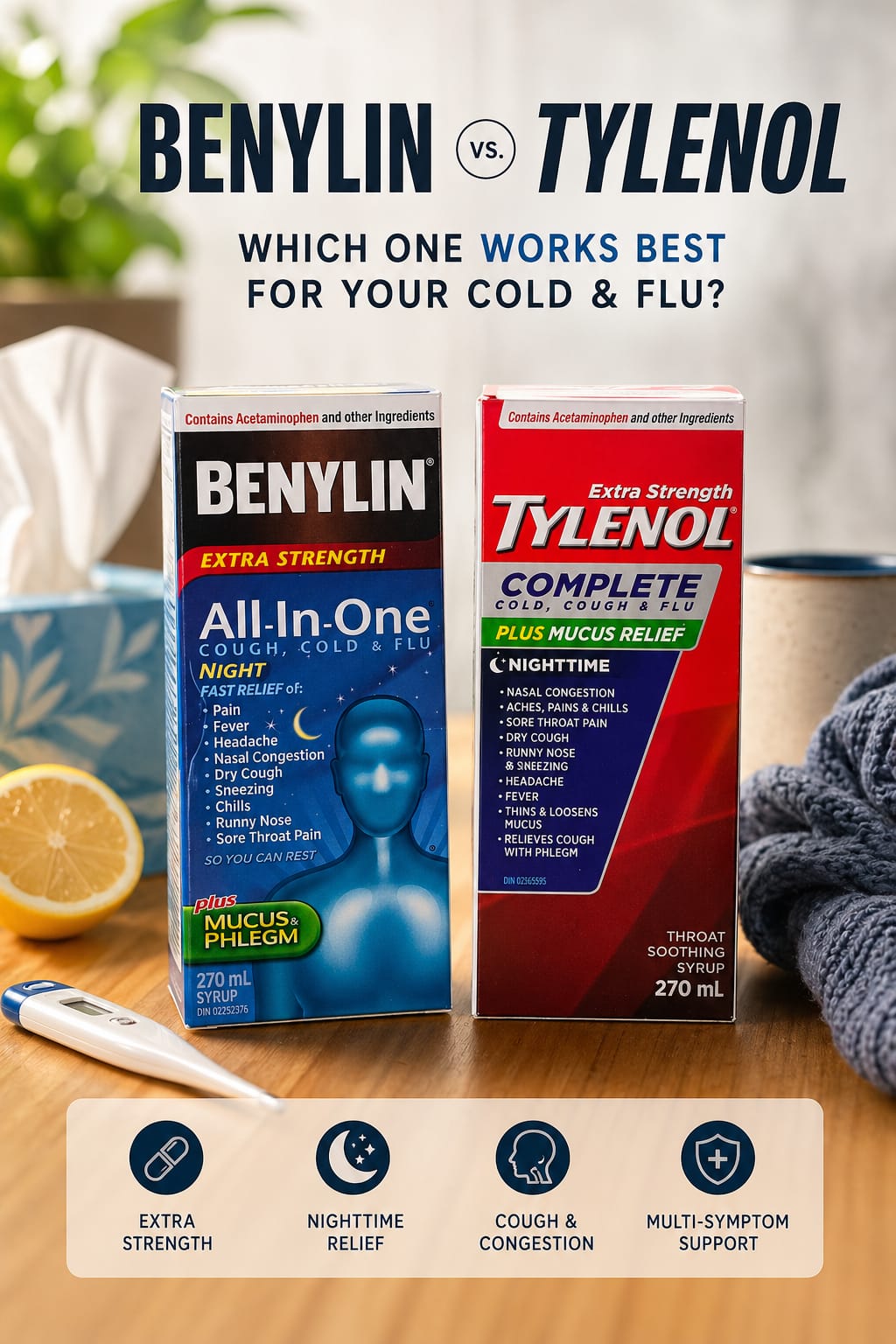
There they were. Two boxes, side by side on the shelf, both promising the same thing: relief from the miserable cocktail of symptoms that is the modern cold , nasal congestion, dry cough, sore throat, fever, chills, sneezing, runny nose, and that particular brand of full-body betrayal that makes you want to lie on the floor and stare at the ceiling.
On the left: Benylin Extra Strength All-In-One Cough, Cold & Flu Night. Dark blue box. Nighttime formula. Price tag: $14.00 on sale.
On the right: Tylenol Complete Cold, Cough & Flu Nighttime , Extra Strength Plus Mucus Relief. Bold red and white design. Price tag: $25.00.
I picked up both boxes. I looked at the Benylin. I looked at the Tylenol. I looked at the $11 difference between them. And I thought , as anyone with functioning eyes and a preference for keeping their money would , I should probably read these labels before I decide.
There is a specific kind of confidence that comes from being a careful shopper. I had that confidence. I was about to learn something important about it.
The Label Investigation Begins
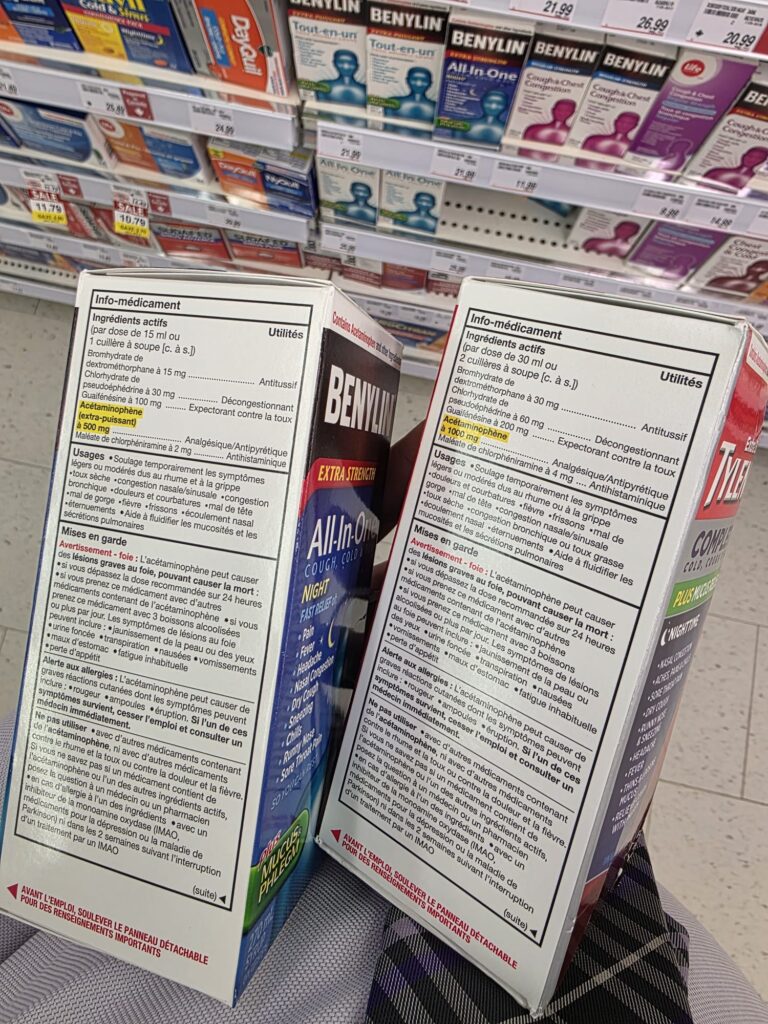
I flipped both boxes over and started reading the ingredient panels , the ones printed in tiny font that most people ignore, the ones that contain the actual, technical truth about what you’re putting into your body.
Both products are throat-soothing syrups. Both are 270 mL. Both are nighttime formulas. Both contain the same category of active ingredients. So far, so identical. And then I got to the acetaminophen , the painkiller and fever reducer that is the backbone of both products.
Active Ingredients — Side by Side
Benylin (per 15 mL dose)
- Dextromethorphan HBr — 15 mg (Antitussive)
- Pseudoephedrine HCl — 30 mg (Decongestant)
- Guaifenesin — 100 mg (Expectorant)
- Acetaminophen — 500 mg
- Chlorpheniramine Maleate — 2 mg (Antihistamine)
Tylenol (per 30 mL dose)
- Dextromethorphan HBr — 30 mg (Antitussive)
- Pseudoephedrine HCl — 60 mg (Decongestant)
- Guaifenesin — 200 mg (Expectorant)
- Acetaminophen — 1000 mg
- Chlorpheniramine Maleate — 4 mg (Antihistamine)
Key: Tylenol’s dose is 30 mL. Benylin’s dose is 15 mL. Every ingredient in Tylenol is exactly double , because the serving size is exactly double.
And there it was. 500 mg of acetaminophen in Benylin. 1,000 mg in Tylenol. My brain lit up. Aha. The Tylenol has double the active medication. The more expensive product is giving you twice the punch. I’m getting ripped off by buying the cheaper one.
I nearly put the Benylin back on the shelf right then. I nearly congratulated myself for being a diligent label reader. I nearly paid $25 for the Tylenol with the satisfied glow of a person who had done their homework.
But Then I Noticed the Number I Almost Missed
Something made me pause. Something small. Something I almost scrolled past in my mental spreadsheet of ingredient comparisons. It was a tiny, seemingly insignificant detail printed right next to the ingredient list.
The dose size.
Benylin: per 15 mL (one tablespoon).
Tylenol: per 30 mL (two tablespoons).
Tylenol’s dose is exactly double the size of Benylin’s dose. That means the 1,000 mg of acetaminophen in Tylenol is simply Benylin’s 500 mg… taken twice. Every single active ingredient in Tylenol is precisely double Benylin’s , because you’re taking twice as much liquid.
Milligram for milligram, per unit of dose, these two products are identical. Pharmacologically, chemically, therapeutically , the same formula. One just tells you to take 15 mL at a time. The other says 30 mL. That’s it. That is the entire difference.
The $11 price gap? Gone. The Tylenol “advantage”? An illusion. The bargain I thought I was walking away from? Waiting for me right there at $14.
15
Benylin dose: 15 mL
500 mg acetaminophen per dose
Same concentration per mL as Tylenol
30
Tylenol dose: 30 mL
1,000 mg acetaminophen per dose
Same concentration per mL as Benylin
I stood in that aisle for a long moment. Not out of confusion , out of the particular, humbling silence that follows when you realize you almost outsmarted yourself.
What Actually Happened in That Aisle
Here is what almost happened: I, a person who congratulated myself for reading the label, almost made the exact same mistake as someone who didn’t read the label. I had the right instinct , check the ingredients , but I stopped one step too early. I saw the big number and assumed it meant more medicine. So can heal me faster LOL. I didn’t ask the obvious follow-up question: more medicine per what?
This is a phenomenon that pharmacists and consumer health advocates talk about all the time, though most of us never encounter it so viscerally. When comparing dosage claims between pharmaceuticals, the serving size is the critical denominator. A product that lists 1,000 mg of an ingredient sounds dramatically more potent than one listing 500 mg , until you notice one dose is twice the volume of the other.
The same trick hides in nutrition labels on food. A bag of chips may claim “only 150 calories per serving” while defining a serving as five chips. A bottle of juice might say “no sugar added” while listing the portion as half a glass. We know this happens in food. We are more suspicious of food marketing. But somehow, with pharmaceutical products, our guard drops. We assume the packaging is scientific, neutral, trustworthy. We assume the number is the whole story.
It rarely is.
✦
The Lesson That Lives in This Story
I walked out with the Benylin. I saved $11 AND I got better medicine, AND Its stronger and can get me back to life FASTER, My cold, eventually, went away. But I’ve been thinking about this moment ever since , not because of the medicine or $11 bucks, but because of what it revealed about a kind of thinking I do constantly, and probably do wrong more often than I realize.
Here is what I mean.
There is a version of “being smart” that is actually just being fast. It’s the version where you gather a little more information than the average person, feel the satisfaction of that effort, and stop. You read the label. You checked the ingredients. You compared the numbers. You’re ahead. Most people wouldn’t have done that. You win.
But being truly careful isn’t about gathering information. It’s about gathering the right information and understanding its context. A number without its denominator is meaningless. A claim without its conditions is marketing. A comparison without its unit of measurement is just noise that feels like signal.
You can be the most careful person in the room and still miss what matters , if you stop asking questions one step too soon.
Think about how often this plays out in real life. Someone compares two job offers by looking only at base salary, not benefits, tax implications, cost of living, or growth potential. Someone chooses a loan based on the monthly payment, not the total interest paid. Someone picks a health insurance plan by the premium, not the deductible. Someone reads a headline and shares it without reading the article. Someone reads the article and doesn’t question the methodology of the study it cites.
At every level of almost every decision, there is a number. And beside it, if you look carefully enough, there is a denominator , a context, a condition, a catch , that changes what that number actually means.
Five Things This $14 Bottle of Cold Medicine Taught Me
- Read further than the number.Any statistic, any claim, any comparison , your first question should always be: per what? Per dose? Per year? Per what baseline? Per whose definition? The number is the beginning of the story, not the end.
- Being thorough and being fast are different skills.Speed is rewarded in our culture. Efficiency is praised. But genuine thoroughness requires slowing down past the point where you feel like you’ve already found the answer. The real information is usually one question deeper than where most people stop.
- Pharmaceutical labels are not simple , read them like a contract.Every medication tells you what it contains, but only if you read the dose size alongside the ingredient list. Before you compare any two medicines, check whether the serving sizes are the same. If they’re not, normalize the numbers. A 500 mg dose at 15 mL and a 1,000 mg dose at 30 mL are mathematically identical formulas.
- Confidence from partial information is more dangerous than ignorance.When you know nothing, you ask questions. When you think you know something, you stop asking. The most dangerous moment in any decision is when you feel like you’ve done enough research. That’s exactly when to push one step further.
- The small details hold the most leverage.One number , 15 versus 30. That’s all it was. Not a complex pharmacological difference. Not hidden fine print. A serving size, right there on the label, that flipped the entire comparison. Small things don’t stay small. They become the difference between the right decision and the wrong one.
I think about that moment in the aisle sometimes. Not with embarrassment , I caught it, after all. But with a kind of respect for how easy it is to nearly miss something that’s sitting right in front of you, visible to anyone willing to look at it with both eyes open. The world is full of 15s pretending to be 30s. Read accordingly.
A Final Word About Medication Safety
Beyond the philosophical lesson, there is a genuinely practical one here that I want to name clearly: reading pharmaceutical labels carefully can protect your health, not just your wallet.
Acetaminophen , the active ingredient in both products, and the most widely used over-the-counter painkiller in the world , is safe at recommended doses and potentially dangerous above them. Both of these products carry clear warnings on the label about liver risk from exceeding the daily maximum. If you were taking Tylenol Complete and Benylin simultaneously thinking they were different formulas , because you compared the per-dose numbers without checking the dose size , you could inadvertently double up on acetaminophen without realizing it.
This is not a rare scenario. It’s a common one. Many cold medicines, flu medicines, sleep aids, and even some headache remedies contain acetaminophen. They don’t all advertise it boldly. Reading the label , the full label, including the serving size , is not just smart shopping. It is basic safety.
Take the extra thirty seconds. Flip the box over. Read the small print. Ask the follow-up question. And if you’re ever unsure about any medication , combinations, interactions, dosing , a pharmacist is right there in the same building, and they are genuinely one of the most underused free resources in everyday healthcare.
Your health deserves more than a glance at the front of the box.
✦
I got home, took my 15 mL of Benylin, and went to sleep. The scratchy throat eased. The congestion softened. By Thursday I was mostly human again. And somewhere in the fog of that recovery, I wrote this down , because it felt like one of those small moments that is quietly, disproportionately worth remembering.
Read the label. All of it. Down to the number that seems like a footnote. Especially that number.
— That’s where the real story is.